
We will explained OpenTelemetry Context Propagation in a simple and beginner-friendly way.
Table of Contents
What is Opentelemetry Context Propagation
Context Propagation is the mechanism by which trace-related data travels along with a request as it moves through multiple services in a distributed system.
Think of it as a tracking slip attached to a request, so every service knows:
•“This request belongs to which journey?”
•“Who called me?”
•“Where did this request come from?”
Why Context Propagation is Needed
Imagine an e-commerce application built using microservices.
A single user action:
User clicks “Place Order”
Behind the scenes, this one action triggers multiple services:
API Gateway
↓
Order Service
↓
Payment Service
↓
Inventory Service
↓
Database
From a user perspective, it’s one request.
From a system perspective, it’s many services.
Problem Without Context Propagation
If each service works independently:
• API Gateway creates its own trace
• Order Service creates another trace
• Payment Service creates another trace
Result:
• You see multiple unrelated traces
• You cannot answer:
• Where did the delay happen?
• Which service failed?
• How long did the full request take?
What Gets Propagated (Very Important)
When context propagation is enabled, three main things travel together:
• Trace Context
• Baggage
• W3C standards
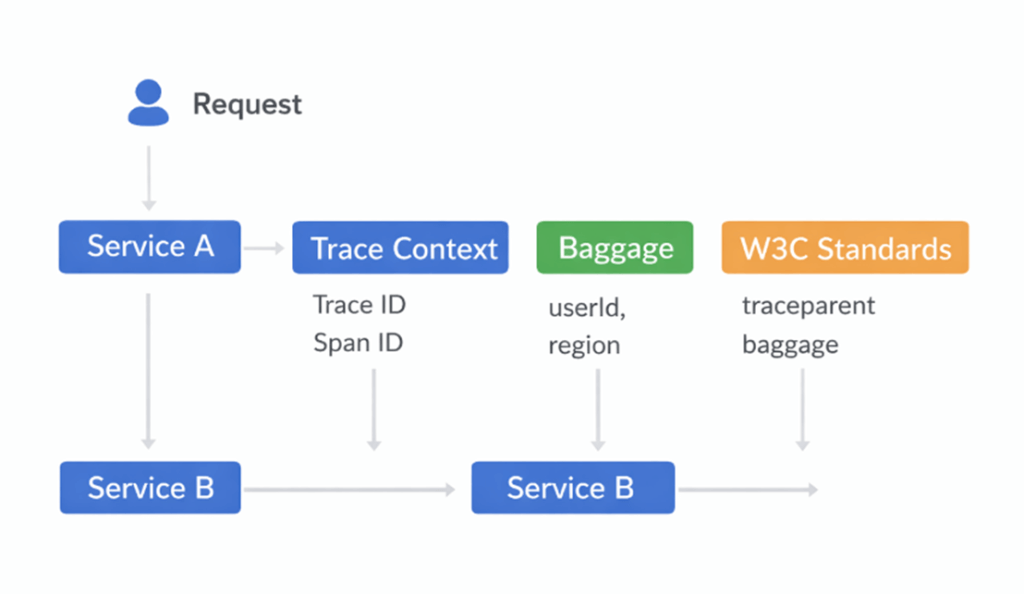
Trace Context
• Trace Context contains tracing information
• Travels with the request across services
• Used to link spans together
Trace Context Includes:
• Trace ID
• Span ID
Trace ID
• Unique identifier for an entire request
• Same Trace ID across all services
• Connects all spans into one trace
Example
Trace ID: abc123xyz
Trace ID answers the question: “Which request is this?”
Span ID
• Represents a single operation
• Each service creates its own span
• Forms parent-child relationships
Example
API Gateway → Span 1
Order Service → Span 2
Payment Service → Span 3
Spans show what each service did and how long it took.
Baggage
Baggage allows propagating custom key-value pairs across services.
Since it travels with every request, avoid including sensitive data such as credentials,
API keys, or PII.
• Custom key-value data
• Propagates with the request
• Adds business context
Example
userId=1234
region=India
orderType=premium
Best Practice (Highlight):
Keep baggage small
Avoid sensitive data
W3C Standards for Context Propagation
W3C (World Wide Web Consortium) defines global standards that specify how trace and context information should be propagated across distributed systems in a consistent and interoperable way.
These standards ensure that different services, languages, and observability tools can understand and continue the same trace.
Why W3C Standards Are Important
•Modern systems use multiple programming languages
•Services may use different observability tools
•Without standards, traces would break across boundaries
•
Key W3C Headers Used in Context Propagation
• raceparent → Order tracking number
• Tracestate → Courier-specific notes
• Baggage → Extra delivery instructions
How Context Propagation Works
Steps
1. Request starts → Trace is created
2. Context added to request headers
3. Next service extracts context
4. New span is created
5. Context is forwarded
Keywords to Highlight:
• Inject
• Extract
• Continue
Context Propagation Example
E-commerce Order Flow
This allows us to see the complete journey of one order
User → API Gateway → Order Service → Payment Service
• Same Trace ID flows across all services
• Each service creates its own Span ID
• All spans form a single trace
Without Context Propagation
Without context propagation, traces are isolated and meaningless.
• Each service creates its own trace
• No relationship between traces
• Difficult debugging
• No end-to-end visibility
Conclusion:
• Context Propagation enables end-to-end tracing
• Trace Context connects services
• Trace ID identifies the request
• Span ID represents operations
• Baggage adds business metadata
• W3C standards ensure interoperability
Related Articles:
OpenTelemetry Instrumentation | Code-based vs Auto Instrumentation
Reference:
